

Doubting "perfect"
日本の美意識を語る際、必ずと言っていいほど持ち出されるのが「侘び寂び」という言葉である。
When people discuss Japanese aesthetics, "wabi-sabi" is almost invariably the term that comes up.
もっとも、これほど他言語に訳しにくい言葉も少ない。「不完全の美しさ」と説明されることが多いが、それは全体像の一面を捉えたにすぎない。
Yet few words are as hard to translate. It is often explained as "the beauty of imperfection", but that captures only one side of the whole picture.
「侘び」はもともと、思うようにならない境遇を嘆く気持ちを表していた。それがやがて、乏しさの中にこそ豊かさを見出す態度へと、意味を変えていったのである。
"Wabi" originally expressed sorrow at circumstances that would not go one's way. Over time its meaning shifted toward an attitude of finding richness precisely in scarcity.
一方の「寂び」は、時を経て古びたものに宿る静かな趣を指す。新品にはない落ち着きが、使い込まれた道具や苔むした石灯籠から漂ってくる。
"Sabi", on the other hand, refers to the quiet charm in things aged by time. A calm that new goods lack drifts off well-used tools and moss-covered stone lanterns.
日常会話で使われる「侘びしい」は、みすぼらしくて心細いという否定的な響きを帯びる。同じ語源の言葉が正反対の評価を持つところに、この概念の奥深さがある。
The everyday word "wabishii" carries a negative ring: shabby and forlorn. That words of the same root can carry opposite valuations is exactly what gives the concept its depth.
俳諧の世界でも、静けさと孤独の中に深い味わいを見出す「さび」は、松尾芭蕉の句風を語るうえで欠かせない理念の一つとされる。
In the world of haikai poetry as well, "sabi", finding deep savor in stillness and solitude, is regarded as one of the ideals indispensable to discussing the style of Matsuo Basho.
Born in the tea room
この美意識が磨かれた舞台は、室町から安土桃山の時代にかけて広まった茶の湯である。
The stage on which this sensibility was polished was the tea ceremony, which spread from the Muromachi to the Azuchi-Momoyama period.
豪華な舶来の道具がもてはやされる中で、千利休は飾り気のない茶碗や、小さな草庵風の茶室を好んだとされる。
While lavish imported utensils were all the rage, Sen no Rikyu is said to have preferred plain tea bowls and small, hermitage-style tea rooms.
茶室の入口がわざと狭く造られているのも、身分や肩書きを外して向き合うためだと説明されることがある。身をかがめなければ、誰も中に入れない。
The deliberately small entrance of a tea room is sometimes explained as a way to set aside rank and title when facing one another. Without bowing, no one can get in.
利休の美学は、単なる貧しさの称賛ではない。何かを削ぎ落とすことで、残ったものの存在感を際立たせようとする、極めて意識的な選択だった。
Rikyu's aesthetics were not a mere celebration of poverty. They were a highly deliberate choice: strip things away so that what remains stands out all the more.
床の間に生けられるのも、豪華な花束ではなく、野に咲く花を一輪だけ、という場合が少なくない。余白があるからこそ、その一輪の命が際立つ。
What is arranged in the alcove is often not a gorgeous bouquet but a single wildflower. Precisely because there is blank space, the life of that one bloom stands out.
Accepting impermanence
侘び寂びの根底には、あらゆるものは移ろい、いずれ朽ちるという仏教的な無常観がある。完全であることはむしろ不自然で、欠けや歪みこそ自然な姿だと考えるのである。
At the root of wabi-sabi lies the Buddhist view of impermanence: everything changes and eventually decays. Perfection is rather unnatural, and chips and distortions are nature's own form.
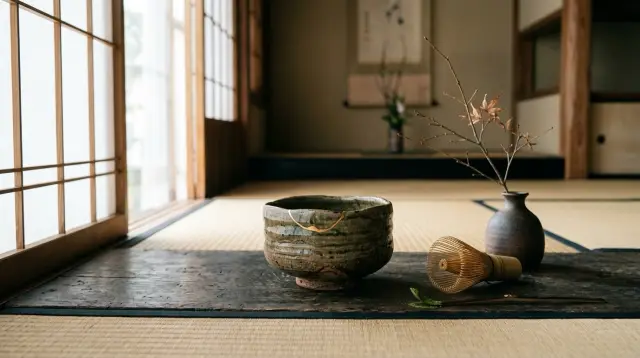
手びねりの茶碗の歪みや釉薬の流れ、使ううちに生まれる細かなひび。これらは欠点として隠されるのではなく、二つとない個性として愛でられてきた。
The warp of a hand-shaped bowl, the run of a glaze, the fine cracks that appear with use. These were not hidden as defects but cherished as individuality found nowhere else.
畳が日に焼けて青から飴色へ移り、障子紙が少しずつ黄ばんでいく。そうした変化を「傷み」ではなく「育ち」と呼ぶ感覚が、日本の住まいには根付いてきた。
Tatami mats fade from green to amber in the sun, and shoji paper yellows little by little. The sense of calling such changes "growth" rather than "damage" has taken root in Japanese homes.
均一に大量生産された製品にはない、手仕事ならではの揺らぎが、そこに温もりを与えている。
The wavering that only handwork can produce, absent from uniform mass-produced goods, gives these objects their warmth.
効率や新しさを追う世の流れをよそに、この感覚は今も暮らしの隅々に息づいている。
Regardless of the world's chase after efficiency and novelty, this sensibility is still alive in every corner of daily life.
In life today
近年、断捨離やミニマリズムが注目を集める中で、侘び寂びは海外でも「簡素で心地よい暮らし」の象徴として紹介されるようになった。
In recent years, as decluttering and minimalism have drawn attention, wabi-sabi has come to be presented abroad as a symbol of a simple, comfortable life.
ただ、現代の「おしゃれな簡素さ」と侘び寂びを同一視することには、注意が必要だ。前者が整えられた見た目を重んじるのに対し、後者は整いきらない余地をも肯定する。
Still, we should be careful about equating today's "stylish simplicity" with wabi-sabi. Where the former prizes a polished appearance, the latter also affirms the room left unfinished.
割れた器を漆と金で繕う金継ぎが近年見直されているのも、傷を消すのではなく物語として残す、この発想と無縁ではない。
The recent revival of kintsugi, mending broken vessels with lacquer and gold, is not unrelated to this idea of keeping a scar as a story rather than erasing it.
物があふれる時代に生きる私たちにとって、「足りないこと」を貧しさではなく余白と受け止める視点は、新鮮な響きを持つに違いない。
For those of us living in an age overflowing with things, the view that "not having enough" is not poverty but blank space must sound refreshing.
何にもまして大切なのは、ものを手放すことではなく、手元にあるものを長く慈しんで使う姿勢だろう。
Above all, what matters is probably not getting rid of things but the attitude of using what one has, with care, for a long time.
旅先で苔の庭や古い茶室に出会ったら、写真を撮る前に、しばらく黙って眺めてみるといい。何も足さず何も飾らない空間が、何を語りかけてくるかに耳を澄ませるのである。
If you come across a moss garden or an old tea room on your travels, try gazing at it in silence for a while before taking a photo. Listen for what a space that adds nothing and decorates nothing is saying to you.
Words in this article
傷や古びを受け入れる寛容さなくして、侘び寂びの美しさは理解できない。古びた器は、見る者にそこへ流れた時間を想像させずにはおかない。
Without the tolerance to accept scratches and age, one cannot grasp the beauty of wabi-sabi. An old vessel cannot help making its viewer imagine the time that has flowed through it.
もちろん、完璧を目指す努力そのものを否定しているわけではない。名工といえども、精一杯の仕事の先に偶然が入り込む余地を残してきたのである。
Of course, this does not deny the effort to aim for perfection itself. Even master craftsmen have left room for chance to enter beyond their best work.
不完全さを恥じるのではなく、そこに美しさを見つける。侘び寂びは、忙しい現代人に「立ち止まって見る」ことを静かに促している。それは、完成を急がない生き方への誘いでもある。
Rather than being ashamed of imperfection, find beauty in it. Wabi-sabi quietly urges busy modern people to stop and look. It is also an invitation to a way of living that does not rush toward completion.