

What the character 間 says
「間」という言葉は、二つの物や出来事の間にある隔たりを指す。空間にも時間にも使えるところに、この語の特徴がある。
The word "ma" refers to the interval lying between two things or two events. Its distinctive feature is that it can be used for both space and time.
「間」の字は、もとは門の扉の隙間から月の光がさし込む形を表した字に由来するとされる。暗い隙間に光を見るという発想が、すでに字形の中にある。
The character 間 is said to derive from one that originally depicted moonlight streaming through the gap of a gate's doors. The idea of seeing light in a dark gap is already present in the shape of the character itself.
実際、「空間」「時間」「世間」「人間」など、日本語の基本的な言葉の多くが、この「間」の字を含んでいる。
In fact, many basic Japanese words, such as "space", "time", "society", and "human", contain this character 間.
哲学者の和辻哲郎は、「人間」という語が本来は人と人との間柄を意味することに着目し、人を関係の中で捉える倫理学を論じた。
The philosopher Watsuji Tetsuro noted that the word "ningen" originally meant the relationship between people, and argued for an ethics that grasps the person within relations.
つまり「間」は、何もない隙間ではなく、ものとものを結びつけ、意味を生み出す場として捉えられてきたのである。
In other words, "ma" has been understood not as an empty gap but as a place that connects things and gives rise to meaning.
Ma in architecture
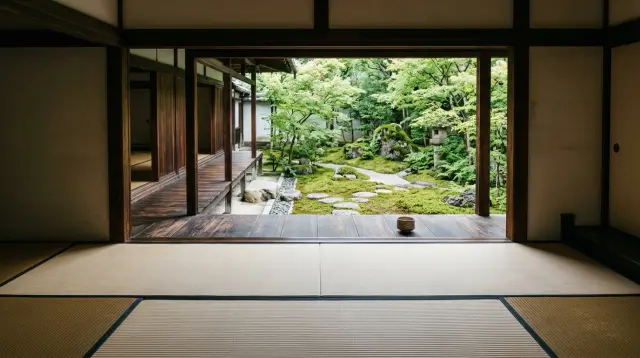
伝統的な日本の住まいでは、柱と柱の間を単位として空間を測ってきた。一間はおよそ一・八メートルで、部屋の広さも「六畳間」のように畳の数で表す。
In traditional Japanese homes, space has been measured in units of the span between pillars. One ken is about 1.8 meters, and a room's size is also expressed in tatami count, as in a "six-mat room".
襖や障子で仕切られた部屋は、取り外せば一つの大きな空間に変わる。壁で用途を固定する西洋の部屋とは違い、使い方によって姿を変える可変性がある。
Rooms partitioned by fusuma and shoji turn into one large space when the panels are removed. Unlike Western rooms whose use is fixed by walls, they are changeable depending on how they are used.
玄関で靴を脱いで床に上がる習慣や、土間と座敷の段差も、外と内の「間」をはっきり意識させる仕掛けだ。境目が、そのまま心の切り替えの場になる。
The custom of removing shoes at the entrance to step onto the floor, and the step between the earthen-floor area and the tatami room, are likewise devices that make one clearly aware of the gap between outside and inside. The threshold itself becomes a place to switch one's frame of mind.
縁側は、室内とも屋外ともつかない中間の場所である。隣人が気軽に腰かけて話ができる縁側ならではの距離感が、地域の付き合いを支えていた。
The engawa is an in-between place that is neither indoors nor outdoors. The sense of distance unique to the engawa, where neighbors could sit down easily and chat, used to support community ties.
日本の庭にあっては、石と石の間隔や、何も植えない白砂の広がりも設計の一部である。見る人が想像で補う余白が、あえて残されているのだ。
In a Japanese garden, the spacing between stones and the spread of white sand where nothing is planted are also part of the design. Margins that viewers fill in with imagination are deliberately left.
谷崎潤一郎は随筆『陰翳礼讃』の中で、光で隅々まで満たさず、薄暗がりに美しさを見出す日本の感覚を論じた。明るさと暗さの間にも、豊かな階調があるのだ。
In his essay "In Praise of Shadows", Tanizaki Jun'ichiro discussed the Japanese sense of finding beauty in dimness rather than filling every corner with light. Between brightness and darkness, too, there is a rich gradation.
Ma in the performing arts
能の舞台では、役者がほとんど動かない時間が長く続く。観客はその静止の中に、動きよりも濃い感情を見てとる。
On the Noh stage, long stretches pass in which the actor barely moves. In that stillness, the audience perceives emotion more intense than movement.
作曲家の武満徹は、沈黙と釣り合うほど強い一音を求めたと言われる。音と音の間の無音もまた、音楽の重みを決める要素なのである。
The composer Toru Takemitsu is said to have sought a single sound strong enough to balance against silence. The soundlessness between notes is also an element that determines music's weight.
落語や漫才では、笑いを取れるかどうかは「間」で決まると言われる。同じ台詞でも、ほんの一瞬の遅れや早さで、客席の反応が大きく変わるのである。
In rakugo and manzai, it is said that whether you get a laugh is decided by "ma". Even with the same line, a split-second delay or haste changes the audience's reaction greatly.
剣道や柔道では、相手との距離と呼吸を測る「間合い」が重視される。間合いを読むことなしに、有効な一撃を放つことはできない。
In kendo and judo, "maai", the gauging of distance and breath relative to the opponent, is stressed. Without reading maai, one cannot deliver an effective strike.
Ma in everyday conversation
日常会話にも「間」は顔を出す。「間が悪い」は時機がずれていること、「間が持たない」は沈黙が気まずくて場を保てないことを表す。
\"Ma\" shows up in everyday talk too. \"Ma ga warui\" means mistimed, and \"ma ga motanai\" means the silence is so awkward that one cannot hold the moment together.
「間髪を入れず」は、髪の毛一本さえ入る隙間がないほど素早く、という意味だ。わずかな隙間すら許さない速さを、「間」を使って描いている。
\"Kanpatsu wo irezu\" means so swiftly that not even a single hair could fit in the gap. A speed that allows not the slightest gap is depicted using "ma".
日本語には、仲間、合間、手間、居間のように、「ま」と読む「間」を含む言葉が数多くある。どれも、何かと何かの間にある人や時、場所を指している。
Japanese has many words that read 間 as "ma", such as nakama (companion), aima (interval), tema (trouble), and ima (living room). All of them point to a person, time, or place lying between one thing and another.
文章についても、書かれていないことを読み取る「行間を読む」という表現がある。言葉の少ない短歌や俳句が長く愛されてきたのも、読み手に委ねる余白の大きさゆえだろう。
For texts, too, there is the expression "reading between the lines", picking up what is not written. That tanka and haiku, with so few words, have long been loved is probably thanks to the great margin they leave to the reader.
日本人の会話では、相手の話が終わってから一拍置いて答えることが、思慮深さや敬意の表れとされる場合がある。沈黙は、必ずしも拒絶や無関心を意味しない。
In Japanese conversation, waiting a beat after the other has finished speaking before answering is sometimes seen as a sign of thoughtfulness and respect. Silence does not necessarily mean refusal or indifference.
もっとも、この感覚は日本に限らず、多くの文化に見られる。ただ、沈黙を「間」と名付け、積極的に味わう発想が、この言葉の独自性を支えている。
That said, this feeling is not limited to Japan and is seen in many cultures. But the idea of naming silence "ma" and actively savoring it underlies the word's distinctiveness.
人との距離の取り方にも「間」の感覚は表れる。握手や抱擁ではなくお辞儀で挨拶するのは、触れ合わずに敬意を示す、ほどよい間合いの作り方だと見ることもできる。
The sense of "ma" appears in how one keeps distance from others as well. Greeting with a bow rather than a handshake or hug can be seen as a way of creating a fitting interval, showing respect without touching.
感染症の流行で距離を保つことが求められたとき、「間隔を空ける」という発想が比較的すんなり受け入れられた、と見る人もいる。普段から「間」を意識する暮らしが背景にあったのかもしれない。
When an epidemic demanded keeping distance, some observers think the idea of "leaving a gap" was accepted relatively smoothly. Perhaps a lifestyle that is conscious of "ma" in ordinary times lay in the background.
Words in this article
一方で、学習者が沈黙を恐れて話を急いだり、日本人の無言を拒否と受け取ったりして、すれ違いが生まれることもある。「間」を知ることは、会話の読み方を一つ増やすことでもある。
On the other hand, learners sometimes fear silence and rush their speech, or take a Japanese person's wordlessness as refusal, and misunderstandings arise. Knowing "ma" also means adding one more way of reading a conversation.
何かで満たすことなしに、あえて空けておく。慌ただしく情報があふれる現代だからこそ、「間」を持つ余裕は、改めて価値を帯びているのではないか。
Leaving something deliberately open instead of filling it with anything. Precisely because today is hurried and flooded with information, the capacity to hold a "ma" may be taking on renewed value.