

What are kamiza and shimoza?
日本のビジネスマナーには、「席次」という考え方があります。席にも順位があり、一番目上の人や大切なお客様が座る席を「上座」、それ以外の人が座る席を「下座」と呼びます。
Japanese business etiquette has the idea of seating order, 「席次」. Seats are ranked: the seat for the most senior person or an important guest is the 「上座」, and the seats for everyone else are 「下座」.
基本の考え方は簡単です。入口から遠くて、落ち着いて座れる席ほど上座で、出入りしやすく、人の出入りに気を配る席ほど下座です。
The basic idea is simple. The farther a seat is from the door and the calmer it is to sit in, the higher the rank; the easier it is to get in and out of, and the more it requires watching the comings and goings, the lower the rank.
会社や地域によって細かい違いはありますが、迷ったときは「入口から遠い方が上座」と考えれば、大きく間違えることはありません。
Details differ by company and region, but when in doubt, thinking “the seat farther from the door is the higher one” will keep you from going far wrong.
Meeting rooms and reception rooms
会議室では、入口から一番遠い奥の席が上座です。入口に近い席が下座で、そこには一番若い社員が座ります。資料の配りや飲み物の対応がしやすいからです。
In a meeting room, the seat farthest from the entrance is the 「上座」. The seat nearest the door is the 「下座」, where the most junior employee sits, since it is easiest to hand out materials and see to drinks.
応接室では、ソファが上座で、一人用の椅子が下座です。お客様を迎えるときは、「どうぞ、奥の席にお掛けください」とご案内します。
In a reception room, the sofa is the 「上座」 and single chairs are the 「下座」. When welcoming a guest, say 「どうぞ、奥の席にお掛けください」.
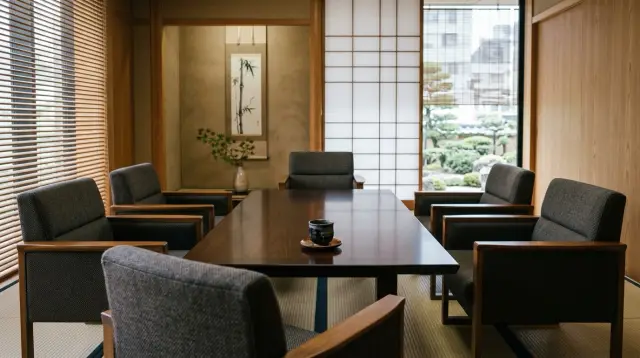
部屋によっては、窓からの景色が良い席や、絵や飾りが見える席が上座になることもあります。和室では、床の間を背にした席が一番上です。
Depending on the room, a seat with a good view through the window or one facing a picture or decoration may be the top seat. In a Japanese-style room, the seat with its back to the 床の間 alcove is the highest.
Taxis and elevators
タクシーでは、運転手の後ろの席が一番の上座です。次が助手席の後ろ、その次が後部座席の真ん中で、助手席が一番の下座です。目下の人が助手席に座り、行き先を運転手に伝えたり、料金を払ったりします。
In a taxi, the seat behind the driver is the highest. Next is the seat behind the front passenger, then the middle of the back seat, and the front passenger seat is the lowest. The junior person sits in front, tells the driver the destination and pays the fare.
ただし、上司や取引先の人が自分で車を運転する場合は、助手席が上座になります。後ろに座ると運転手扱いしているように見えるからです。
However, when your superior or a business partner drives the car themselves, the front passenger seat is the top seat. Sitting in the back would look as if you were treating them like a chauffeur.
エレベーターでは、操作盤の前が下座です。一番目下の人が先に乗って「開く」ボタンを押し、お客様や上司を先に乗せます。降りるときも、ボタンを押したまま、お客様や上司から先に降りてもらいます。
In an elevator, the spot in front of the control panel is the 「下座」. The most junior person boards first, holds the “open” button, and lets the guest or boss board next. When getting off, keep holding the button and let the guest or boss exit first.
電車や新幹線で向かい合う四人席に座るときは、進行方向を向いた窓側の席が一番の上座です。次が進行方向を向いた通路側、その次が反対向きの窓側です。
In a four-person facing seat on a train or Shinkansen, the window seat facing the direction of travel is the highest. Next is the aisle seat facing forward, then the window seat facing backward.
食事の席でも、考え方は同じです。レストランでは、入口から遠い席や、景色の良い席が上座になります。先に入って待つときは、下座の席で待ちましょう。
The same idea applies at meals. In a restaurant, a seat far from the entrance or with a good view is the top seat. If you arrive first and wait, wait in a lower seat.
席の順番に自信がないときは、「どちらにお掛けしましょうか」と相手に聞いてしまうのも、一つの方法です。知らないふりをして間違えるよりも、丁寧に尋ねる方がずっと好印象です。
If you are unsure about the seating order, simply asking 「どちらにお掛けしましょうか」 is also one way. Asking politely leaves a much better impression than pretending to know and getting it wrong.
お客様として訪問したときも、自分から先に上座に座ってはいけません。「どうぞ」とすすめられてから、「失礼いたします」と言って腰を下ろします。荷物は、足元か椅子の横に置き、机の上には載せません。
Even when you visit as a guest, do not sit down in the top seat on your own. Wait until you are invited with 「どうぞ」, then say 「失礼いたします」 and sit. Put your bag by your feet or beside the chair, not on the table.
Sample dialogue: guiding a guest to a seat
グエン「本日はお越しいただき、ありがとうございます。会議室までご案内いたします。こちらへどうぞ。」
Nguyen: “Thank you for coming today. Allow me to show you to the meeting room. This way, please.”
山田「ありがとうございます。」
Yamada: “Thank you.”
グエン「どうぞ、奥の席にお掛けください。ただいま、田中が参りますので、少々お待ちいただけますでしょうか。」
Nguyen: “Please take the seat at the back. Tanaka will be here shortly, so would you mind waiting a moment?”
山田「いえ、そちらの席ではなく、私はこちらで結構ですよ。」
Yamada: “No, I'm quite happy with this seat rather than that one.”
グエン「恐れ入ります。それでは、失礼いたします。」
Nguyen: “Thank you, that is kind of you. If you will excuse me, then.”
お客様が遠慮して下座に座ろうとしたら、一度は「どうぞ、こちらへ」とすすめます。それでも断られたら、無理にすすめずに、相手の気持ちを受け入れましょう。
If a guest modestly tries to sit in a lower seat, offer the better one once with 「どうぞ、こちらへ」. If they still decline, do not insist; accept their feelings.
Words in this article
席次のルールは、覚えるためのものではなく、相手への敬意を形にしたものです。迷ったときは、「相手が一番落ち着ける席はどこか」と考えてみましょう。小さな気配りの積み重ねが、信頼につながります。
The seating rules are not just for memorizing; they give shape to respect for the other person. When unsure, ask yourself, “Which seat would be the most comfortable for them?” Small acts of consideration add up to trust.